

|
|
|
|
|
|
|
|
|
|
Indianapolis Star & News Library, Part 1I stared at the Star/News Library in December 1986, and I remember that because the cards and envelopes we used for archiving clippings were color-coded to make them easy to spot in the drawers (1986 was blue and 1987 green). 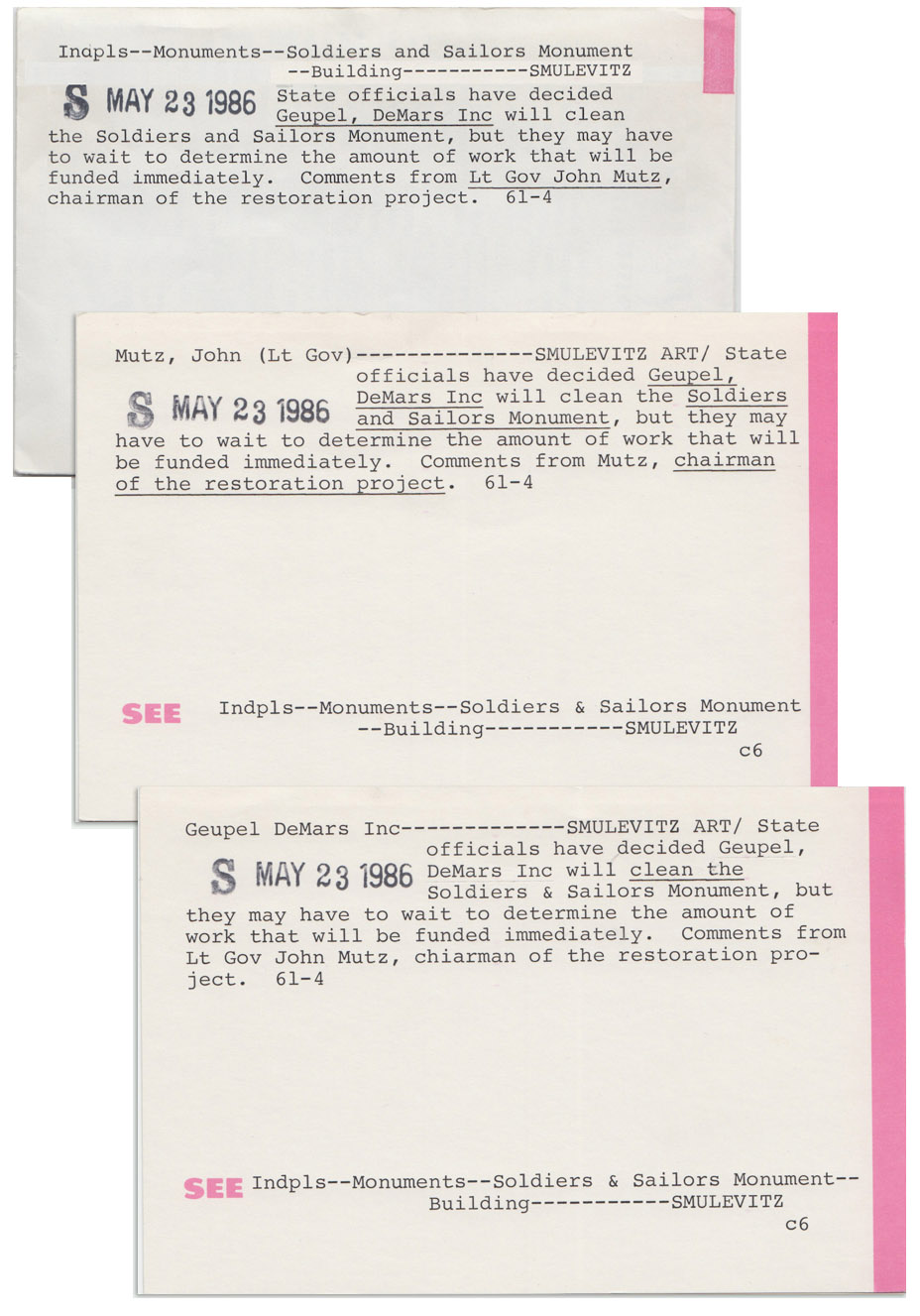
This was an old-style, pre-digital filing system and it was a wonder to behold. The system dated back to 1916 and had been refined and improved over the decades. The cards and envelopes were about 4x6 and got filed by name and topic in several rows of metal filing cabinets. The Library staff was about 20-25 people, most of them women. There was a Head Librarian and two supervisors to cover the morning and evening shifts. Two or three librarians worked in the photo area, one was exclusively dedicated to taking phone calls from the public and the rest of us worked on the archiving process while also answering phone calls from the newsrooms. The Star was a morning paper and The News came out in the afternoon so twice a day one of the supervisors would cut all the articles out of the paper (attaching the jumps) and would then mark each of them up with a red pencil. The main name or topic would be circled to indicate that this would go on the envelope in which the clipping itself would be enclosed. Other key names and topics would be underlined or hand-written in the margins and these were for the cross-reference cards. The topic headings were quite specific and had a hierarchy. For example: "Public Schools--Indpls--Teachers--Salaries" or "Indpls--Monuments--Soldiers and Sailors Monument--Building." The main task was to read the article and the write an abstract of it that could be typed on the cards and envelopes. The fundamental abstract would be the same, but for each cross-reference card it was important to add a line or two on the relevance that specific person or topic. Even folding up a large clipping to fit in such a small envelope was a skill to be learned. I liked abstracting well enough, but was not very fast at it -- until I realized that our newest typewriter had a memory and could repeatedly type out the same block of text. I was better at the reference side of the job and over a couple of years my job evolved so that I was the "chief" reference librarian. This was just a few years before the modern Internet (defined as WWW) and the only sources we had to answer reference questions were a few hundred books we had on the shelves and our own clipping files. A few times a day we called one of the subject desks at the public library. Although this was mostly a pre-digital world, we did have some pretty powerful online tools at our disposal. The newsrooms worked on dumb terminals of an ATEX mainframe, but we in the Library had one of the only PCs in the building. We used it to dial in via modem to one of several databases of published newspapers, magazines and other print materials. The service we used most was Nexis. Virtually every large newspaper in the country was available, as were newspapers and magazines from all over the world. Unfortunately, we could not routinely use this resource to answer whatever questions came our way. Because of the cost, this was limited to research requests that had been signed off on by one of the editors. There was a fee for every search attempt and additional fees for each display of a directory or a full article. It could add up quickly, especially if you were not sufficiently careful and skilled in how to do a search. This was done using Boolean query statements using AND and OR statements combined within parentheses and using truncation to account for plurals and word variations. So a simple query would be: (dog OR cat) AND food This would retrieve any articles containing either the words "dog" and "cat" if that article also contained the word "food." However, this search might not retrieve articles in which only the plural form was used. The phrase "food for dogs" would not be a match because, to a computer in that era, "dog" was a different word than "dogs." This became more complicated when concepts had less precise terminology or there were common synonyms. A "plane crash" was also an "aviation accident" or an "airline accident." Also, the two words in the concept might not be precisely adjacent, as in the phrase "a plane has crashed." So a search might be: (aviation OR plane OR jet OR airline) WITHIN4 (crash! OR wreck! OR accident!) In this example, the "within" connector states how many words might be in between, while the exclamation points were for truncation. Each service had its own search syntax, so proximity could be "NEAR4" or "ADJ4", and an asterisk might be the symbol for truncation. There was no room for error, and a small keystroke error could invalidate the search or retrieve inappropriate results. And each action you took cost a fee -- plus an overall fee for how many minutes you were connected. There was one other important resource we had available to us. The newsroom was still on the ATEX mainframe system. Each reporter used ATEX to write stories, plus the wire feeds flowed through it, but deleted themselves daily to make room for the ongoing feed. The library also had some space where we kept some ready-access files, such as lists of former governors and mayors. Some we compiled ourselves as events happened. For example, whenever there was a plane crash or a tornado, the new article always referenced when the last time this thing happened. If there was room in the paper that day, they might include a full chronology, and these came from the library's files. Although I did a lot of work on these files, they had been started by Barb Hoffman before I was on the staff. In 1992, the publisher established a "Future Task Force" to research and monitor various trends affecting the newspaper industry. The committee was led by Myrta Pulliam, and there were six or eight of us altogether. We each focused on a different trend/topic, and I chose the personal computer trend. At that time, only about 25% of American households owned a personal computer, and most of those did not also have a modem to access anything outside of their own files. Less than 2% had ever accessed "the Internet," which at that point was Usenet bulletin boards and command-line tools such as Telnet and Lynx through which skilled users could access files and directories if they understood the command codes. The World Wide Web had recently been invented, but was not yet available to the general public. 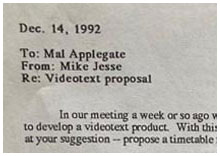
It was, however, possible for anyone to set up a file server and allow dial-up access to that server to anyone with a computer and modem. America Online and Prodigy are examples of this. In this time period, a handful of newspapers were trying to do something similar for their local readers, and this was known as 'videotext." I wrote a proposal advocating that we launch a videotex program, and outlined how it could be done. This was well received by the publisher, but then I was offered the library director job at the Dayton Daily News, and so I left the Star before that could be pursued. Soon after this, the World Wide Web emerged, and the modern Internet was born. I would spend the next 20 years pursuing one version of this project or another, and I had some success, but it never gained traction in the industry at large. I don't want to sound like an old man shaking his fist and saying, "If they'd only listened to me!" but I do believe that the history of the newspaper industry in my lifetime could have played out very differently if this type of approach had been adopted. |
||
|
-- |
||